
By Emkionyx Team ·
Why Is Your Commercial Building Wasting Energy? The Role of BMS Integration
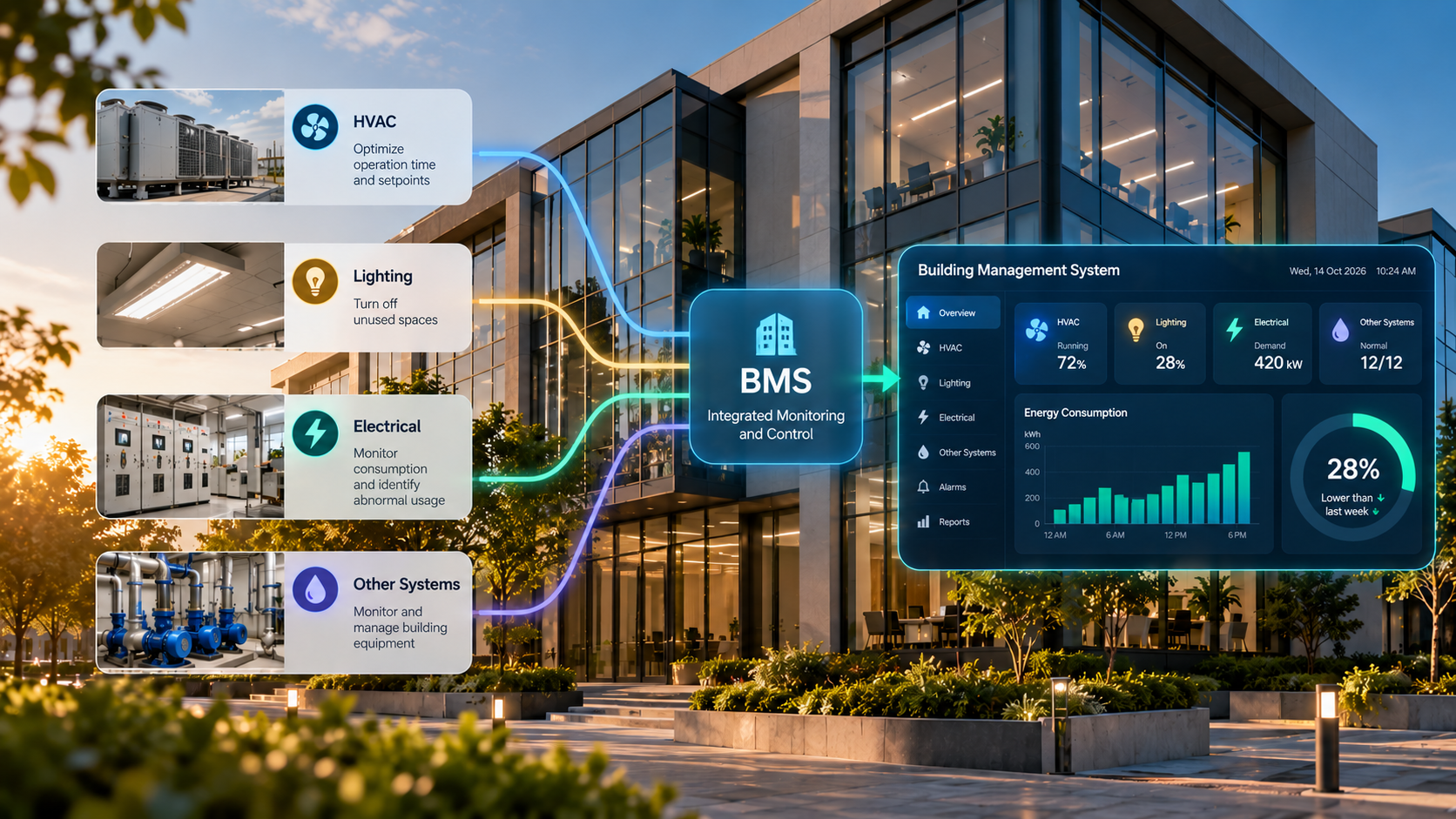
Commercial buildings consume energy throughout the day to maintain comfortable indoor temperatures, provide ventilation, operate lighting and power essential equipment. Yet rising electricity bills do not always mean that a building needs new HVAC equipment or a complete infrastructure upgrade. In many cases, energy waste comes from how existing building systems operate, how they are controlled and whether their performance can be monitored effectively.
An air-handling unit may continue running after office hours. Lighting may remain switched on in unoccupied areas. Energy meters may record excessive consumption without helping facility teams identify the equipment responsible. Meanwhile, HVAC controls, electrical monitoring and lighting systems may operate through separate platforms, making it difficult to understand how one system affects another.
These problems become harder to investigate when building data is scattered across disconnected systems. Facility managers may know how much electricity the building consumes, but not when, where or why unnecessary consumption occurs.
A Building Management System (BMS) can help address this challenge by bringing compatible building systems and their operational data into a coordinated monitoring and control environment. When properly designed, integrated and maintained, a BMS can help facility teams identify inefficiencies, improve control strategies and make better-informed decisions about energy use.
This article explores where commercial buildings commonly waste energy, why disconnected systems make the problem harder to solve, and how BMS integration can support more efficient building operations.
Why Do Commercial Buildings Waste So Much Energy?
Energy waste in commercial buildings often develops gradually. Equipment may have been installed correctly, but operating schedules, control settings and maintenance practices can become misaligned with how the building is actually used.
HVAC systems are a major area to investigate because they must maintain indoor temperature, ventilation and occupant comfort across changing weather and occupancy conditions. If cooling equipment operates longer than necessary, setpoints are inappropriate or air-handling equipment runs without sufficient demand, energy consumption can increase without an obvious fault appearing on the control panel.
Lighting is another potential source of unnecessary consumption. Common areas, meeting rooms, service spaces and individual floors may remain illuminated even when they are not in use. Where lighting controls operate independently of occupancy schedules or other building information, identifying these patterns may require manual checks.
Electrical equipment can also consume energy outside its intended operating period. Pumps, fans and other plant equipment may continue operating according to fixed schedules even when building requirements have changed. Equipment degradation, incorrect sensor readings and control faults can further affect performance.
The important distinction is that high energy consumption does not automatically prove that a system is inefficient. A building may consume more electricity because of longer operating hours, higher occupancy, weather conditions or changes in business activity. Facility teams need reliable operational data to distinguish necessary consumption from avoidable waste.
What Are the Most Common Causes of Energy Waste in Commercial Buildings?
The following issues are useful starting points when investigating unexpectedly high energy consumption. Their actual impact depends on the building, installed equipment and operating conditions.
| Potential issue | Why it matters | How BMS monitoring can help |
|---|---|---|
| HVAC running outside occupied hours | Cooling and ventilation may operate when fewer spaces require them | Compare operating schedules, equipment status and available occupancy information |
| Incorrect temperature setpoints | Equipment may work harder than necessary to maintain unsuitable settings | Review setpoints, temperature trends and equipment response |
| Lighting in unused areas | Lights may remain on after working hours or during periods of low occupancy | Monitor compatible lighting controls and review schedules |
| Simultaneous heating and cooling | Different systems may work against each other when controls are poorly coordinated | Compare available temperature, valve, damper and equipment-status data |
| Equipment operating continuously | Pumps, fans or other equipment may run longer than intended | Review runtime trends and investigate deviations from configured schedules |
| Poorly performing sensors | Incorrect readings can cause unsuitable control decisions | Identify inconsistent readings and flag devices for inspection |
| Repeated alarms or control faults | Persistent problems may go unnoticed when alerts are scattered across platforms | Centralize relevant alarms and provide context for investigation |
These are potential causes, not a diagnosis of every commercial building. A site assessment, equipment review and analysis of energy data are necessary to determine which issues are present and what corrective action is appropriate.
Why Do Disconnected Building Systems Make Energy Management Difficult?
Many commercial buildings contain equipment installed at different stages of construction, renovation and expansion. HVAC controllers, electrical meters, lighting controls and other building systems may come from different manufacturers and use different communication methods.
Each system may perform its individual function while providing limited visibility into the building as a whole. An energy meter can show rising consumption, for example, but the facility team may need to open another application to check HVAC operation and a separate interface to review lighting schedules.
This fragmentation creates several practical challenges.
First, information becomes harder to compare. Different platforms may display data in different formats, use inconsistent equipment names or record information at different intervals. Without a consistent view, investigating the cause of an energy anomaly can require manual data collection and repeated checks.
Second, operational relationships can be overlooked. A rise in electricity consumption may coincide with longer HVAC operating hours, an unexpected change in occupancy or a control fault. If the relevant data is not available together, the team may struggle to establish what happened.
Third, alarms and trends can lose their value when nobody has the time or context to investigate them. A system may record an abnormal condition, but if the alert is buried among unrelated notifications or is not assigned to the appropriate team, the underlying issue can remain unresolved.
The U.S. Department of Energy identifies interoperability challenges, proprietary systems and fragmented building operations as obstacles to wider use of advanced building controls. Although the specific equipment and standards vary by market, the underlying integration challenge also matters to commercial buildings in India. Source: U.S. Department of Energy - About Building Controls
A coordinated BMS architecture can reduce this fragmentation by presenting compatible information through a common operational interface. The goal is not necessarily to replace every existing system. It is to make the required data accessible and useful across the building's operational workflows.
How Can BMS Integration Help Reduce Energy Waste?
BMS integration connects compatible equipment, controllers, meters and other building systems so that facility teams can monitor their operation from a coordinated platform. Depending on the architecture and configuration, the system may also support automated schedules, control sequences and notifications.
The first benefit is centralized visibility. Rather than relying exclusively on separate equipment interfaces, operators can review relevant HVAC status, temperature readings, lighting information and electrical consumption in one place. This makes it easier to understand operating conditions and identify areas that deserve investigation.
The second benefit is better-informed control. Where equipment supports the required functions, a BMS can apply schedules and approved control strategies that align operation with building requirements. For example, an HVAC schedule may be adjusted to reflect actual operating hours, while compatible lighting controls may follow defined occupancy or time-based rules.
The third benefit is the ability to investigate abnormal conditions. Historical trends and alarms can help facility teams identify equipment that runs longer than expected, temperature readings that repeatedly deviate from their targets or consumption patterns that differ from normal operation.
Integration can also support coordination between systems. Where the equipment and design allow it, information from occupancy sensors, schedules and environmental measurements may inform control decisions. Any automated sequence must be configured to preserve required ventilation, occupant comfort, equipment constraints and other operational requirements.
Importantly, a BMS does not reduce energy consumption simply because multiple systems appear on the same dashboard. The benefits depend on accurate data, compatible equipment, suitable control logic, proper commissioning and a process for acting on the information.
How Does HVAC Integration Affect Commercial Building Energy Consumption?
HVAC integration deserves particular attention because heating, cooling and ventilation must respond to changing weather, occupancy and indoor conditions.
Consider an office building where the HVAC system follows a fixed operating schedule. On some days, particular floors may be lightly occupied or meeting rooms may remain unused for extended periods. If the system continues operating at its normal settings regardless of demand, it may use more energy than necessary.
A properly configured BMS can help facility teams compare schedules, indoor temperatures, equipment status and available occupancy data. Where supported by the installed controls and approved design, the system can adjust operating times or other control parameters to better match actual requirements.
Setpoint management is another consideration. If temperature targets are unsuitable or inconsistent across connected equipment, the resulting control behaviour may increase energy use or affect comfort. Reviewing trends and control sequences can help identify settings that need attention.
The BMS may also help identify unusual equipment runtime. If a fan, pump or air-handling unit operates significantly longer than its established pattern, an operator can investigate whether the cause is a schedule, control fault, maintenance issue or genuine operational requirement.
These examples illustrate why monitoring and control should work together. Energy data can indicate that a problem exists, while HVAC operating data helps facility teams investigate the possible cause.
No single control strategy is suitable for every building. Changes must account for climate, equipment design, ventilation requirements, occupancy patterns and the building's intended operation.
How Can Energy Monitoring Help Identify Hidden Inefficiencies?
Energy monitoring turns electricity consumption into information that can be reviewed over time. However, the usefulness of the data depends on how it is collected, organized and interpreted.
A building-wide meter provides an overview of total consumption, but it may not show which floors, tenants or systems are responsible for a change. Additional meters and suitable integrations can provide more detail, allowing facility teams to investigate consumption at a more useful level.
For example, an office building may record a higher-than-usual electricity load after normal working hours. A whole-building meter can identify the timing of the increase. When combined with compatible HVAC status and lighting data, the facility team may be able to determine whether certain equipment continued running after the building was expected to be unoccupied.
Historical trends are useful for establishing normal operating patterns. Teams can compare similar days, operating periods or areas, while accounting for relevant differences in occupancy, weather and business activity.
Energy monitoring can also help evaluate the outcome of an operational change. If an HVAC schedule is adjusted, the facility team can review subsequent consumption and operating data to see whether the intended result occurred without compromising comfort or ventilation.
For meaningful evaluation, establish a baseline before changing control settings. Record the relevant operating conditions, define which meters and systems will be included, and use consistent measurement periods. This makes it easier to distinguish the effect of a control change from other factors affecting energy demand.
What Is the Difference Between Energy Monitoring and Energy Optimization?
Energy monitoring and energy optimization are closely related, but they serve different purposes. Monitoring helps businesses understand how energy is being consumed, while optimization uses that information to improve how building systems operate.
| Aspect | Energy Monitoring | Energy Optimization |
|---|---|---|
| Primary purpose | Track and understand energy consumption | Reduce avoidable energy use and improve operating efficiency |
| Main activities | Collect meter readings, review trends and identify anomalies | Adjust schedules, refine control settings and address inefficiencies |
| Role of a BMS | Display consumption data, equipment status and historical trends | Support automated controls and operational changes where configured |
| Example | Identify unusually high electricity consumption after office hours | Investigate the cause and adjust equipment schedules where appropriate |
| Expected outcome | Better visibility into energy use | Potential energy savings and improved operational performance |
A BMS can support both monitoring and optimization, but not every installation provides the same capabilities. A system that only reads meter values cannot automatically control equipment unless the necessary control interfaces and logic are also available.
For example, energy monitoring may reveal that a building consumes significant electricity outside normal working hours. Optimization involves investigating the equipment responsible and implementing appropriate changes, such as adjusting HVAC schedules or correcting control settings.
When evaluating a BMS, determine whether you need visibility into energy consumption, active control of compatible equipment, energy reporting or a combination of these functions. This helps ensure that the selected system supports your operational goals rather than simply displaying energy data.
It is also important to measure results against a suitable baseline. Actual savings depend on the building, equipment, operating conditions and effectiveness of the changes implemented.
How Important Are Open Protocols When Integrating Building Systems?
Open communication protocols can help equipment from different manufacturers exchange information with a BMS. However, protocol compatibility should be verified at the device and application level rather than assumed from a product brochure.
BACnet is widely used in building automation and can support communication with compatible building controllers and equipment. Modbus is frequently used for meters, controllers and other equipment that exposes data through the protocol. MQTT can be useful in connected and IoT architectures where information is exchanged through a publish-and-subscribe messaging model.
These protocols serve different purposes, and their suitability depends on the equipment, required functions and integration architecture. A compatible communication link does not necessarily expose every available data point or allow every control action.
Some projects require gateways or protocol converters to connect equipment that uses different interfaces. Others may require additional engineering to map points, standardize names, configure alarms or validate data quality.
Before selecting a BMS, request an integration schedule that identifies each system, the proposed connection method, the information to be exchanged, required hardware and any limitations. This reduces uncertainty and helps suppliers provide more comparable quotations.
For a deeper comparison, read Emkionyx's related article, BACnet vs Modbus vs MQTT: Which Protocol Is Used in Building Automation?
Can an Existing Commercial Building Be Integrated With a BMS?
Yes, many existing buildings can be integrated with a BMS, but the approach depends on the installed infrastructure and the intended scope.
A retrofit project should begin with an assessment of the existing HVAC controls, electrical meters, lighting controllers, communication interfaces and available technical documentation. The survey should determine which devices can be integrated directly, which require gateways and which may need replacement or additional sensors.
The team should also identify the information that matters most to building operations. Connecting every available data point may increase project complexity without improving decision-making. A phased approach can prioritize systems with clear operational value, such as HVAC status, energy meters and recurring equipment alarms.
The survey should consider network access, wiring routes, controller capacity, equipment warranties, operational downtime and cybersecurity requirements. Where the building must remain in use during installation, the work sequence should be planned to minimize disruption.
Once the system is installed, commissioning should verify that the data is accurate, schedules behave as intended, alarms reach the appropriate operators and control sequences produce the expected results.
A retrofit should not be treated as complete merely because equipment appears on the dashboard. Reliable integration requires testing the behaviour and data of the connected systems under relevant operating conditions.
How Can Businesses Measure Whether BMS Integration Is Working?
The success of a BMS integration project should be evaluated against defined operational objectives rather than the number of connected devices.
Energy consumption is one possible indicator, but comparisons must account for factors that affect demand. A building operating longer hours or accommodating more occupants may use more electricity even if its controls have improved. Weather, occupancy, equipment changes and business activity can also influence results.
Useful measures may include electricity consumption during unoccupied periods, HVAC operating hours, repeated alarms, equipment runtime, indoor temperature consistency and the number of unresolved control issues. The appropriate measures depend on the building and its objectives.
A baseline should be established before implementation or before a significant control change. After commissioning, facility teams can compare results across suitable periods and investigate unexpected changes.
Operational follow-up is essential. If monitoring reveals that equipment runs unnecessarily, the team must determine the cause and implement an appropriate correction. If a control change is made, the results should be checked to confirm that energy performance has improved without compromising indoor conditions or system requirements.
A BMS is most useful when it becomes part of an ongoing process: monitor performance, investigate anomalies, implement corrective action and review the results.
What Should You Look for in a BMS for Energy Management?
Businesses evaluating a BMS should start with the operational outcomes they want to achieve. The selection criteria should then reflect the building's equipment, integration requirements and the capabilities needed by the facility team.
System compatibility: Confirm that the proposed platform supports the required HVAC controllers, electrical meters, lighting controls and other equipment. Request details of supported protocols, gateways and device limitations.
Useful energy data: Check whether the system can collect the meter readings and operating information needed to investigate consumption. Consider data intervals, historical retention, reporting and export options.
Monitoring and control capabilities: Establish whether the requirement is for monitoring only or also includes schedules, setpoint management, automated control and alarm handling. Confirm that the installed equipment supports the intended functions.
Alarm management: Review how abnormal conditions are identified, prioritized and presented to operators. Alarm configuration should make important issues visible without generating excessive notifications.
Scalability: Consider whether the system can accommodate planned additions, additional floors, new meters or further building integrations. Understand any hardware, software or licensing requirements for expansion.
Cybersecurity and access: Evaluate authentication, user permissions, remote access, network segmentation and responsibility for updates and maintenance. Connecting building systems to a common platform should not bypass appropriate security controls.
Commissioning and support: Confirm who will configure the system, test integrations, validate data, train operators and provide documentation. Ongoing support is important because building requirements and equipment conditions change over time.
A supplier should be able to explain how the proposed configuration addresses the building's requirements and identify any assumptions, exclusions or additional work that may affect delivery.
What Information Is Needed to Request a BMS Integration Quote?
A clear project brief helps suppliers assess the scope and prepare a proposal that can be compared with other offers.
Start with the building type, project location, approximate floor area, number of floors and project stage. Describe the main systems that need to be monitored or controlled, such as HVAC, lighting and electrical metering, and indicate whether the building already has a BMS or separate control platforms.
Where available, include floor plans, equipment schedules, existing controller details, meter lists, point schedules and technical specifications. Documentation about communication protocols and current system architecture can be especially helpful for retrofit projects.
Also clarify the intended scope. The requirement may cover a new BMS installation, integration of existing equipment, energy monitoring, control upgrades or expansion of an existing platform. Specify whether the proposal should include hardware, software, gateways, installation, configuration, testing, commissioning and operator training.
Finally, explain the operational problems the project is intended to address. Examples might include high after-hours consumption, fragmented monitoring, limited visibility into HVAC operation or difficulty investigating recurring equipment alarms.
The more clearly these requirements are defined, the easier it is for a supplier to assess compatibility, identify missing information and propose an appropriate solution.
Frequently Asked Questions
Does a BMS automatically reduce electricity bills?
No. A BMS provides monitoring and, where configured, control capabilities that can help identify and address energy inefficiencies. Actual results depend on the building, the installed equipment, the control strategy, commissioning and how the facility team uses the information.
What systems should be integrated first to improve energy management?
The best starting point depends on the building's energy use and operational issues. HVAC controls and electrical meters are often useful starting points because they help teams compare equipment operation with consumption. Lighting controls and other systems can be added according to project requirements.
Can a BMS identify why energy consumption is increasing?
It can help investigate the causes when suitable meter readings, equipment data and historical trends are available. A high-level consumption reading alone may not identify the responsible equipment, so additional monitoring or a site investigation may be necessary.
Is BMS integration possible without replacing existing equipment?
Often, yes. Existing equipment may be integrated if it provides compatible communication interfaces and the required information or controls are accessible. A technical survey is needed to identify limitations, gateways and any components that must be upgraded.
How long does a BMS integration project take?
The timeline depends on building size, equipment compatibility, the number of integration points, installation requirements and commissioning scope. A project involving a few compatible meters may be substantially simpler than integrating multiple legacy systems across a large commercial facility.
What is the difference between BMS integration and an energy management system?
The terms can overlap. A BMS commonly focuses on monitoring and controlling building services, while an energy management system may place greater emphasis on energy data, analysis, reporting and performance tracking. The exact distinction depends on the product and project scope, so businesses should evaluate the capabilities offered rather than the label alone.
Conclusion: Better Building Integration Starts With Better Visibility
Commercial building energy waste is not always caused by inefficient equipment alone. Misaligned schedules, unsuitable control settings, limited metering and disconnected systems can make it difficult to understand how a building operates and where improvements are possible.
BMS integration provides a way to bring compatible building data into a coordinated monitoring and control environment. By connecting relevant HVAC, lighting and electrical information, facility teams can investigate abnormal consumption, review operating patterns and make informed decisions about corrective actions.
However, effective energy management requires more than connecting devices. The system must be designed around operational needs, configured correctly, commissioned thoroughly and supported by a process for reviewing performance over time.
For building owners, facility managers and project consultants, the practical starting point is to identify where energy visibility is limited, determine which systems need to work together and define the outcomes the integration should deliver.
Looking to Improve Energy Monitoring in Your Commercial Building?
Emkionyx works across building management, automation and connected infrastructure. If you are planning a new BMS installation, integrating existing building systems or improving visibility into HVAC and energy consumption, visit our Request a Quote page and submit your project requirements.
Was the blog insightful?
Subscribe to our newsletter so you never miss an update