
By Emkionyx Team ·
BACnet vs Modbus vs MQTT: Which Protocol Is Used in Building Automation?
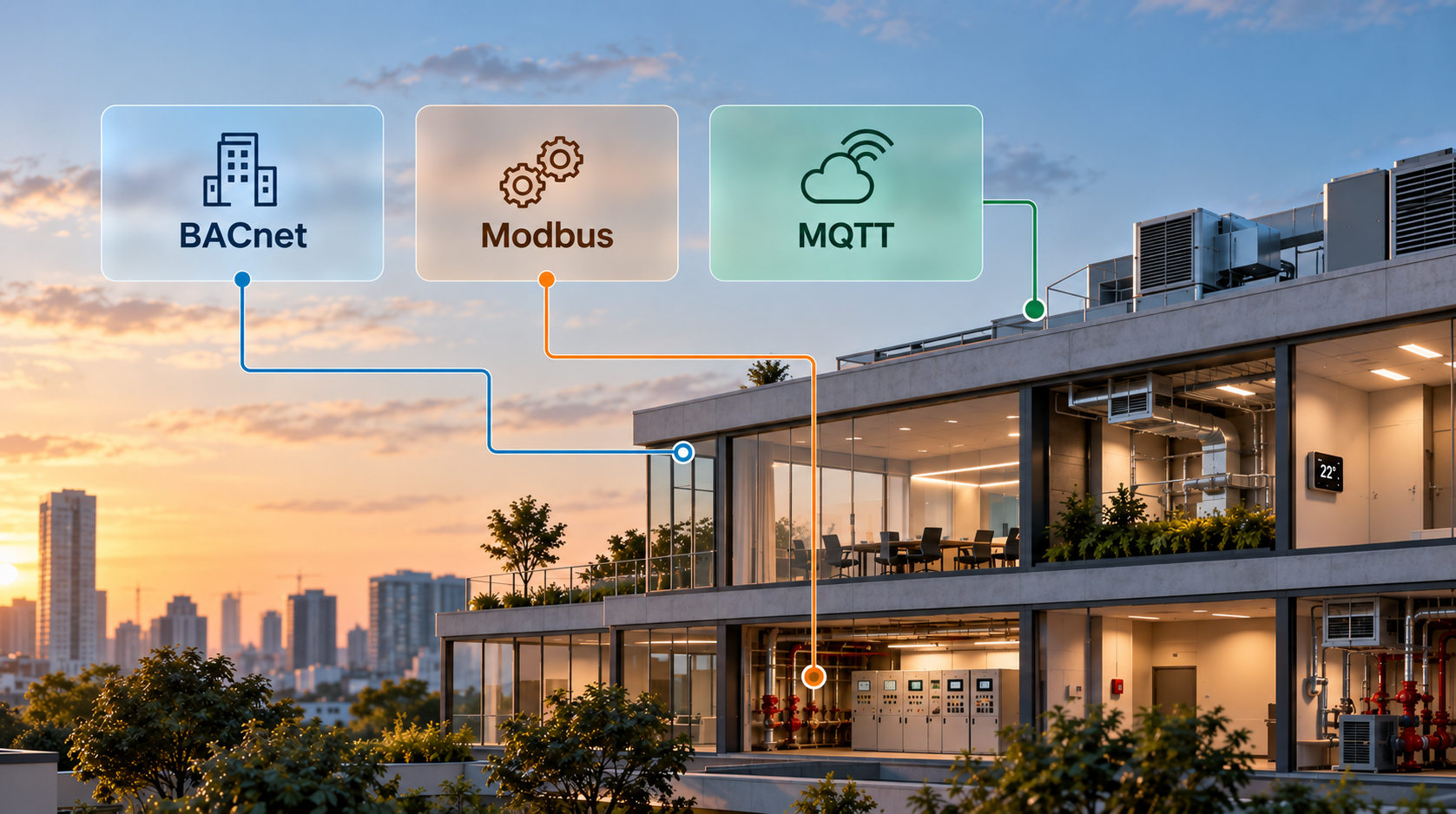
Modern buildings contain a growing number of connected systems. HVAC controllers, chillers, air-handling units, energy meters, lighting systems, fire and life-safety systems, sensors and other equipment continuously generate operational data. For these systems to exchange that data, they need defined methods of communication.
This is where communication protocols such as BACnet, Modbus and MQTT come into the picture.
However, these protocols are not simply three competing options where one replaces the others. They were designed around different communication requirements and are often used at different points within a building's technology architecture. BACnet is specifically designed for building automation and control, Modbus is widely used for communication with industrial and building equipment, and MQTT is designed as a lightweight messaging protocol for connected devices and IoT applications.
Understanding the difference matters when integrating multiple systems into a Building Management System (BMS). A project may use one protocol for HVAC controllers, another for energy meters, and another for moving selected data into an IoT platform.
So, what exactly is the difference between BACnet, Modbus and MQTT, and where does each one fit in building automation?
What Are Communication Protocols in Building Automation?
A communication protocol defines how devices exchange information. It establishes how messages are structured, how devices identify the information they need, and how data is transmitted between systems.
In a building, this communication may happen between a sensor and a controller, between a controller and a BMS, or between an operational system and an IoT platform. The communication requirements at each level can be quite different.
For example, an HVAC controller may need to exchange temperature, operating mode, setpoint and equipment status with a BMS. An energy meter may expose voltage, current, power and energy readings. Meanwhile, an IoT platform may need to receive data from thousands of distributed devices and make that information available to analytics applications.
This is why a modern building does not necessarily use a single communication protocol everywhere. The protocol is generally selected according to the equipment, network architecture, integration requirements and type of information being exchanged.
What Is BACnet and How Is It Used in Building Automation?
BACnet, short for Building Automation and Control Network, is a communication standard specifically developed for building automation and control. BACnet International describes it as a global data communications standard intended to provide vendor-independent interoperability between networked building equipment and control devices.
That building-specific focus is one of the major characteristics that distinguishes BACnet from more general industrial communication protocols.
BACnet is designed around the way building automation systems represent information. Instead of simply exposing raw numerical values, BACnet devices can represent information through standardized objects and properties. This allows a BMS to work with information such as temperatures, equipment states, schedules, alarms and other building-related data in a more structured way.
It is commonly encountered in HVAC and building automation applications, including controllers, air-handling equipment, chillers, variable air volume systems and other building services. Its purpose is not limited to one manufacturer's equipment; interoperability between products from different vendors is one of the reasons BACnet is widely used in building automation.
What Is BACnet/IP?
BACnet/IP allows BACnet communication to operate over IP networks. This makes it possible to integrate building automation devices into Ethernet and IP-based network infrastructure rather than relying exclusively on dedicated field-bus networks.
In larger building automation architectures, BACnet/IP can therefore be used for communication between controllers, supervisory systems and other networked devices.
What Is BACnet MS/TP?
BACnet MS/TP is another form of BACnet communication commonly associated with field-level devices. It operates over RS-485 and uses a master-slave/token-passing mechanism defined by BACnet.
The important point is that BACnet/IP and BACnet MS/TP are not different versions of the BACnet concept. They are different ways of carrying BACnet communication within a building automation network.
What Is BACnet/SC?
As building automation systems increasingly use IP infrastructure, cybersecurity has become an important consideration. BACnet Secure Connect (BACnet/SC) adds secure, encrypted communication to BACnet using WebSockets and TLS, while remaining part of the BACnet family rather than replacing existing BACnet communication options.
What Is Modbus and How Does It Work?
Modbus is an application-layer messaging protocol originally developed for industrial control applications. Unlike BACnet, it was not designed specifically around building automation. Its simple communication model has nevertheless made it common across many types of automation, energy and infrastructure equipment, including building applications.
Modbus uses a client-server communication model in which a client requests information or an operation and a server responds. The protocol defines function codes for operations such as reading and writing data. Information is commonly represented through registers, coils and other defined data areas.
This register-oriented approach is particularly common in equipment where a large number of measurements and operating parameters are exposed as numerical values.
For example, an electrical meter might expose measurements such as voltage, current, power factor and energy consumption through Modbus registers. A controller or BMS integration system can request those values and use them for monitoring, reporting or further processing.
What Is Modbus RTU?
Modbus RTU is a serial implementation of Modbus commonly used over serial networks such as RS-485. It is frequently encountered in field equipment and controllers where relatively simple device-to-device communication is required.
Because the data is organized around addresses and function codes, the integration system needs to know how a particular device has mapped its measurements to Modbus registers. This is why equipment documentation and register maps are important when integrating Modbus devices.
What Is Modbus TCP?
Modbus TCP carries Modbus communication over TCP/IP networks. The Modbus Organization provides a dedicated specification and implementation guidance for Modbus TCP/IP, including communication between clients, servers and gateways.
The underlying Modbus data model remains familiar, but the network transport changes from a serial connection to TCP/IP.
What Is MQTT and Why Is It Used in IoT?
MQTT, or Message Queuing Telemetry Transport, takes a different approach from BACnet and Modbus. It is an OASIS-standard messaging protocol designed to be lightweight and efficient, particularly for IoT and connected devices.
MQTT uses a publish/subscribe model rather than the request/response approach commonly associated with Modbus.
A device can publish a message to a particular topic, while other systems subscribe to topics they are interested in. An MQTT broker receives published messages and routes them to the appropriate subscribers. This separates the publisher from the systems consuming its data.
For example, a temperature sensor could publish a measurement to a topic representing a particular building, floor or piece of equipment. An analytics application, monitoring dashboard or other authorized service can subscribe to that topic without the sensor needing a direct connection to each application.
This model makes MQTT particularly useful when large numbers of distributed devices need to send telemetry to edge or cloud systems. MQTT is designed to have a small protocol footprint and low network overhead, and it supports different Quality of Service levels for message delivery.
BACnet vs Modbus vs MQTT: What Is the Difference?
Although all three can be found in connected building environments, they approach communication differently.
| Feature | BACnet | Modbus | MQTT |
|---|---|---|---|
| Primary purpose | Building automation and control | Device and equipment communication | IoT messaging and telemetry |
| Communication model | Objects, properties and services | Client-server request/response | Publish/subscribe |
| Originally designed for | Building automation | Industrial control | Connected devices and IoT |
| Typical building applications | HVAC, BMS, controllers and building systems | Meters, equipment and controllers | IoT sensors, edge and cloud applications |
| Data representation | Objects and properties | Registers, coils and function codes | Topics and messages |
| Common implementations | BACnet/IP, BACnet MS/TP | Modbus RTU, Modbus TCP | MQTT over IP networks |
| Typical role in an architecture | Building-system communication and integration | Equipment-level data exchange | Data distribution and IoT connectivity |
The table highlights an important distinction: BACnet and Modbus are often involved in communicating with building equipment, while MQTT is frequently used to move data between connected devices, platforms and applications. That does not mean MQTT cannot be used within a building or that BACnet and Modbus cannot feed an IoT platform. It means their communication models and typical roles are different.
Can BACnet, Modbus and MQTT Work Together?
Yes. In fact, using multiple communication protocols within the same building is often more practical than trying to force every device onto a single protocol.
Consider a building with HVAC controllers, electrical meters and IoT sensors. The HVAC controllers may communicate using BACnet, while electrical meters may expose their measurements through Modbus. IoT devices or an edge platform may use MQTT to transmit selected data to a central platform.
A gateway or integration layer can connect these different environments. It can read information from a Modbus device, for example, and make the relevant information available to a BMS using another supported interface. Similarly, operational data from a BMS or field devices can be forwarded to an IoT platform through MQTT.
The objective is not necessarily to eliminate protocol differences. It is to create an integration architecture in which those differences do not prevent systems from exchanging the information they need.
How Do Multiple Protocols Fit Into a Modern BMS?
A modern BMS should not necessarily be thought of as a system that speaks only one protocol.
A building can contain different types of equipment installed at different times, often from different manufacturers. One system may communicate through BACnet, another through Modbus, and newer connected devices may use MQTT or another IoT-oriented interface.
The role of the BMS or integration platform is to bring relevant information together so that operators can monitor systems through a common operational environment. Where protocols differ, gateways and integration software can provide the necessary translation or data exchange.
This becomes increasingly important as buildings move beyond isolated automation systems toward connected infrastructure. Operational data can move from equipment into a BMS, from the BMS into an IoT platform, and from there into analytics, dashboards, alerts or other applications.
In this architecture, BACnet, Modbus and MQTT are not necessarily alternatives. They can be complementary technologies serving different communication requirements within the same building.
How Do You Choose Between BACnet, Modbus and MQTT?
Protocol selection should begin with the equipment and the purpose of the communication rather than with the protocol name itself.
For a building automation project, BACnet may be appropriate when interoperability between building automation controllers and systems is a major requirement. Modbus may be appropriate where equipment already exposes data through Modbus interfaces, particularly meters and other devices with register-based data. MQTT may be appropriate when distributed devices need lightweight messaging and when data needs to move between devices, edge systems or cloud platforms.
Existing infrastructure also matters. Replacing a large installed base of equipment simply to standardize on one protocol may not be practical. Supporting multiple protocols and using appropriate gateways can sometimes provide a more realistic path to integration.
Security, network design, device capabilities, scalability, vendor support and the type of data being exchanged should also be considered before selecting an architecture.
Conclusion
The question is not simply whether BACnet, Modbus or MQTT is the best protocol for building automation. Each addresses a different communication requirement.
BACnet is specifically designed for building automation and control, making it common in BMS and HVAC environments. Modbus provides a widely adopted mechanism for exchanging data with equipment such as meters and controllers. MQTT uses a lightweight publish/subscribe model that makes it particularly useful for connected devices, telemetry and IoT architectures.
In a modern building, these technologies can coexist. The important part is designing an integration architecture that allows equipment, automation systems and higher-level data platforms to exchange the information required for monitoring, control and analysis.
Building automation is therefore less about choosing one protocol and more about making different systems communicate reliably as part of one connected infrastructure.
Was the blog insightful?
Subscribe to our newsletter so you never miss an update