
Structural Health Monitoring in High-Rise Buildings: The Invisible Technology Protecting Tomorrow's Skylines
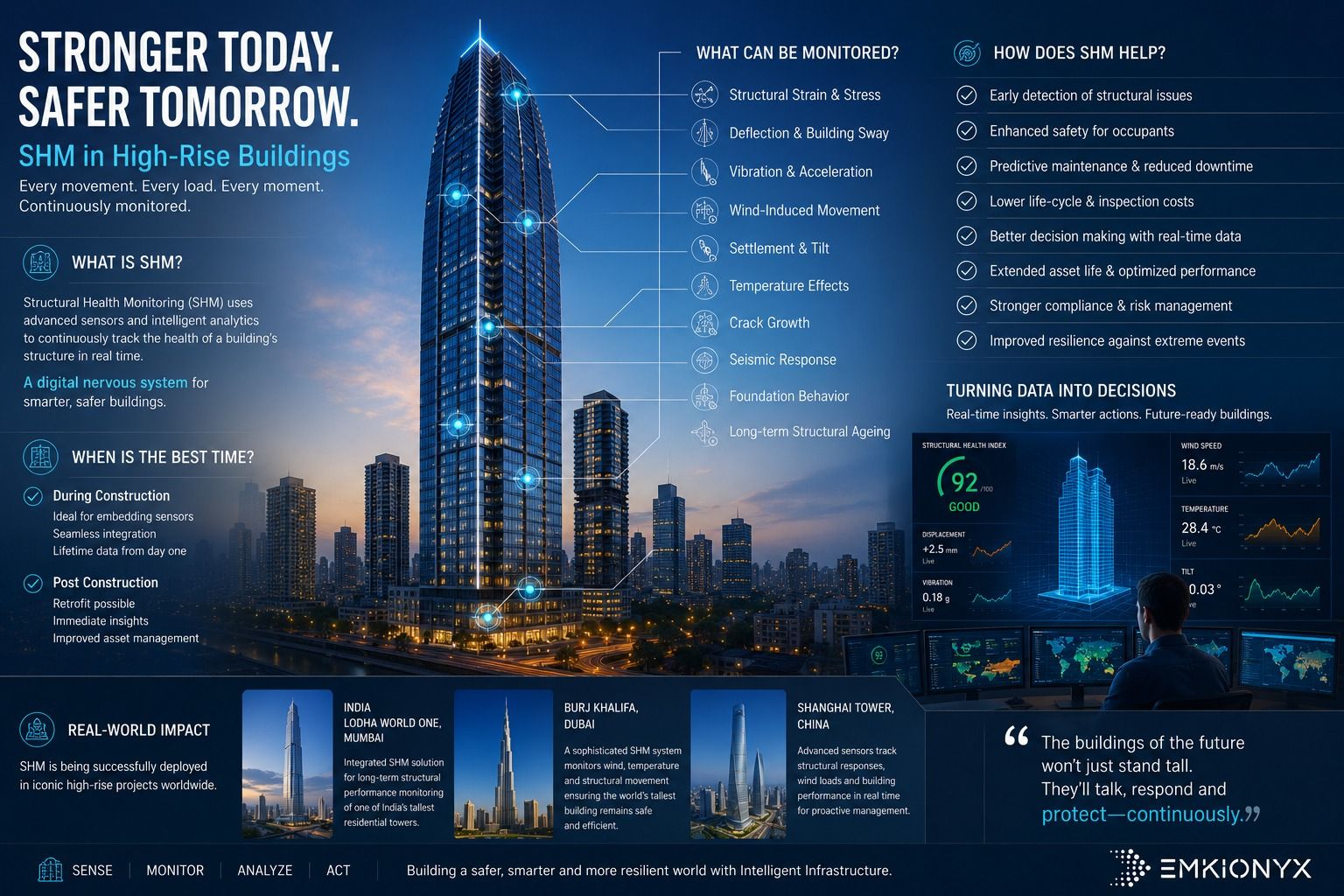
A skyscraper never stops moving. It sways gently in the wind, settles into its foundation, expands and contracts with temperature, and absorbs the quiet stresses of decades of use. Most of this happens far below the threshold of human perception - yet it shapes the long-term safety, performance, and value of the asset. The question facing today's cities isn't whether buildings move. It's whether anyone is listening when they do.
That is precisely the gap Structural Health Monitoring (SHM) was built to close.
Why Do High-Rise Buildings Need Structural Health Monitoring?
The world's skylines are growing faster, taller, and more complex than ever. Rapid urbanization is pushing cities to build vertically rather than horizontally, and architects are pairing greater height with increasingly intricate geometries, composite materials, and slender profiles that push engineering limits.
At the same time, public expectations around safety have shifted. Occupants, regulators, and insurers no longer accept "it was built to code" as a permanent guarantee - they expect ongoing proof that a structure remains sound. Climate change has added urgency to that demand, with more frequent extreme wind events, intense storms, and seismic activity testing structures in ways original design assumptions never fully anticipated.
Layered on top of all this is a broader shift toward data-driven asset management. Building owners are managing portfolios the way investors manage markets - through continuous information, not periodic snapshots. A modern high-rise generates more risk and more data than any previous generation of buildings, and SHM is what turns that data into foresight.
What Is Structural Health Monitoring?
In simple terms, Structural Health Monitoring is the continuous, sensor-based observation of a building's structural condition. Rather than relying solely on manual inspections every few years, SHM uses a network of sensors embedded in or attached to a structure to track how it behaves in real time - under everyday loads, weather events, and over the course of its lifetime.
Think of it as a digital nervous system for buildings. Just as nerves relay signals from the body to the brain, SHM sensors relay structural signals - strain, vibration, tilt, temperature - to a central monitoring platform, where the data is analyzed for early signs of distress. The building, in effect, gains the ability to report on its own health.
When Should SHM Be Implemented?
SHM can be added at two points in a building's life, and the timing matters significantly.
During construction is the preferred approach. Sensors embedded as the structure rises capture true baseline values - how the building behaves before any load, settlement, or environmental exposure has occurred. This baseline becomes the reference point against which every future reading is measured, producing higher-fidelity data, easier sensor integration into structural elements, and lower long-term installation costs.
Post-construction retrofitting is still valuable, particularly for existing high-rises with no monitoring history, but it comes with trade-offs. Sensors must work around finished architecture, access can be limited, and there is no original baseline - only an assumption of what "normal" should look like.
Embedding sensors from day one essentially gives a building lifetime asset intelligence: a continuous, unbroken health record from first concrete pour to final demolition.
What Can Be Monitored in a High-Rise Building?
Modern SHM systems can track a remarkably wide range of structural parameters, including strain and stress in structural members, deflection and building sway, vibration and wind-induced movement, settlement, tilt and inclination, crack initiation and propagation, temperature-driven expansion and contraction, seismic response, foundation behavior, and long-term structural ageing. Together, these data points build a complete, continuously updated picture of structural performance - something periodic visual inspection alone simply cannot achieve.
How Does SHM Benefit Building Owners and Operators?
The operational case for SHM is as strong as the safety case. Continuous monitoring provides early warning of structural anomalies long before they become visible or costly, enhancing occupant safety and giving facility teams the confidence to act proactively rather than reactively. It supports predictive maintenance, replacing guesswork with evidence-based intervention, which in turn reduces unnecessary inspection frequency and lowers long-term maintenance costs. Owners gain better data for capital planning and risk management, stronger compliance positioning, and - increasingly - more favorable conversations with insurers who value demonstrable, real-time risk visibility. The cumulative effect is a longer, more predictable asset lifecycle.
Global Trends Shaping the Future of SHM
SHM is evolving quickly alongside the broader smart buildings movement. AI-powered analytics are enabling systems to detect subtle anomalies humans would miss. IoT-enabled sensor networks are making large-scale deployment more affordable and scalable. Digital twins now allow engineers to simulate structural behavior virtually before issues emerge physically. Cloud-based monitoring platforms give stakeholders anywhere-access to live structural data, and all of this is converging into broader intelligent infrastructure ecosystems that connect buildings, utilities, and cities into a single data fabric.
SHM in Action: Lessons from the World's Tallest Buildings
Some of the world's most iconic towers demonstrate what continuous monitoring makes possible. The Burj Khalifa in Dubai uses an extensive network of accelerometers, GPS units, and wind sensors to track sway, acceleration, and structural response during high winds and seismic tremors, validating decades of design assumptions in real time. China's Shanghai Tower, one of the tallest buildings on earth, deployed more than 400 sensors during construction and into operation, continuously tracking settlement, wind pressure, and inclination - data that has helped engineers understand the building's performance through major typhoon events. Closer to home, India's rapidly growing metropolitan skylines are following a similar trajectory: national mandates now require sensor-based condition monitoring on critical infrastructure, and high-rise developments across cities like Mumbai and Bengaluru are beginning to adopt embedded sensing as a standard part of construction, signaling a broader shift toward proactive, data-led asset management across the region.
Key Takeaways
- Structural Health Monitoring (SHM) is the continuous, sensor-based tracking of a building's structural condition - strain, movement, vibration, and more - functioning as a digital nervous system for the structure.
- High-rise buildings increasingly depend on SHM because of taller, more complex designs, rising safety expectations, climate-driven extreme weather, and the shift toward data-driven asset management.
- Embedding sensors during construction is the preferred approach, capturing accurate baseline data and delivering lifetime asset intelligence; post-construction retrofitting remains useful but with data limitations.
- SHM enables predictive maintenance, early anomaly detection, reduced inspection costs, extended asset life, and stronger compliance and insurance positioning.
- Global landmarks like the Burj Khalifa and Shanghai Tower demonstrate how continuous monitoring strengthens safety and resilience in supertall structures - a trend now gaining momentum in India's high-rise developments.
The Buildings of Tomorrow Will Speak
Skylines are no longer just feats of architecture - they are living systems. The next generation of high-rises won't merely stand tall; they will continuously communicate their health, performance, and resilience through intelligent monitoring networks woven into their very structure. As sensing, AI, and digital twin technologies converge, the line between physical infrastructure and digital intelligence will continue to blur.
At Emkionyx, we see this not as a distant vision but as the present trajectory of intelligent infrastructure - where every beam, every joint, and every foundation has a voice, and every building owner has the data to listen.
Was the blog insightful?
Subscribe to our newsletter so you never miss an update