
The Rise of the Digital Building: Why Fire Alarm Systems Are Becoming Data Platforms
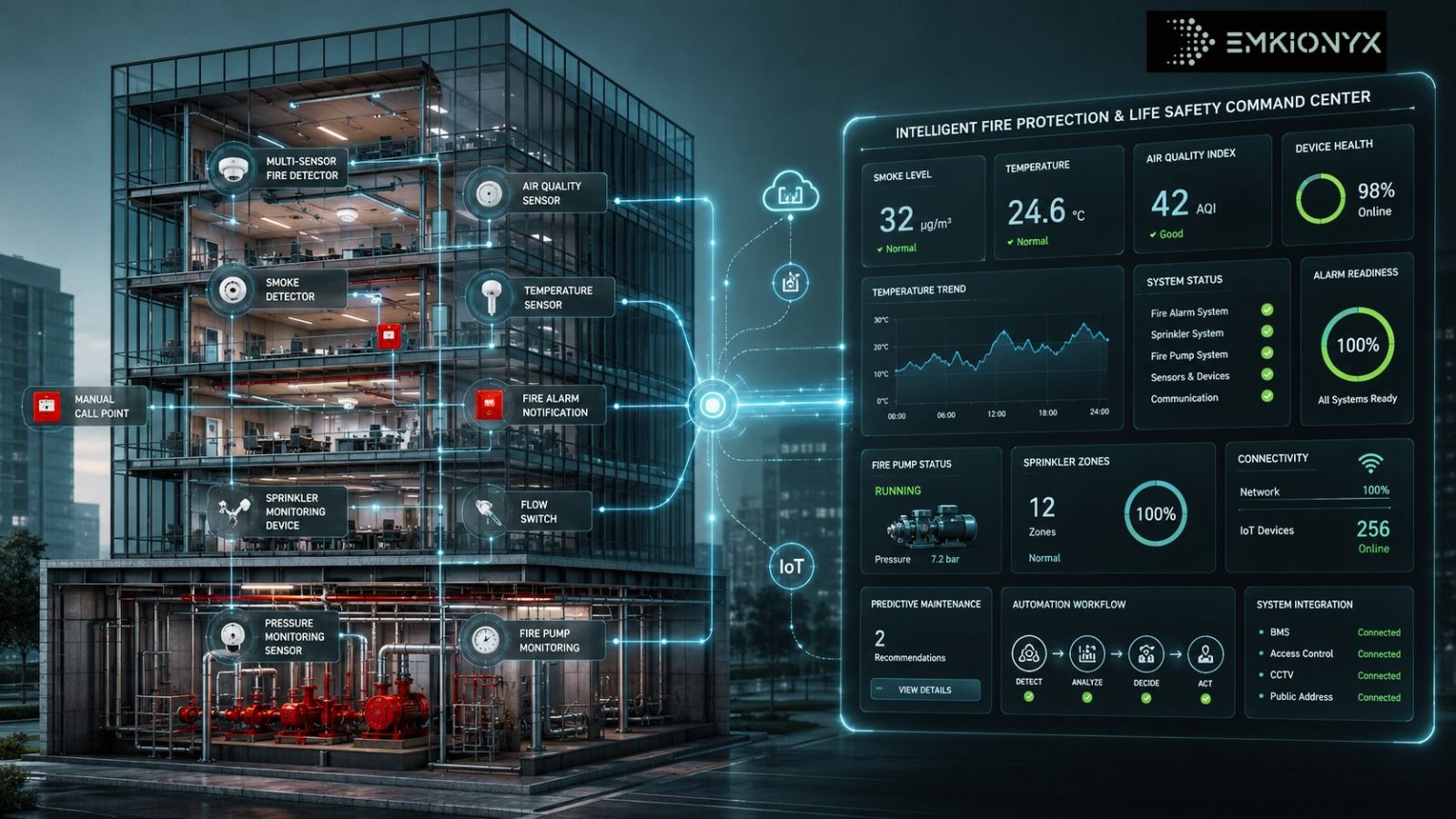
The fire alarm panel of the future won't just detect fires - it will become one of the most important sources of building intelligence.
For decades, the fire alarm system sat in its own world: a closed loop of detectors, panels, and sirens, built to do one job and do it reliably. That job hasn't changed. But the system around it has. Today's fire alarm infrastructure is being pulled into the same digital fabric as HVAC, security, and energy management - and in doing so, it's quietly becoming one of the richest, most continuously updated data sources any building owns.
How Did Fire Alarm Systems Evolve Into Data Platforms?
The shift began with a simple problem: buildings were full of disconnected systems that couldn't talk to each other. A fire event would trip the alarm, but HVAC kept circulating smoke, doors stayed locked, and security had no idea what was happening two floors up. The fix was integration - connecting the fire alarm control panel to the broader building management system (BMS) so a single detected event could trigger a coordinated response across multiple systems at once. What started as a safety fix has become something larger: a life-safety network that generates continuous data on building conditions, not just emergency events.
What Makes a Fire Alarm System Part of a Building's Data Backbone?
The technical answer is open protocols. BACnet, Modbus, and standard Ethernet/IP connections now let fire alarm control panels communicate directly with building automation systems, regardless of manufacturer. When a sensor detects smoke or heat, that signal no longer just sounds a bell - it can simultaneously instruct HVAC to shut down air handlers, unlock egress doors, start exhaust fans, and surface a unified alert on a single operations dashboard. A fire alarm system on an open protocol isn't just a safety device anymore - it's a sensor network with a seat at the building's data table.
How Do Digital Twins Change Fire and Life Safety Management?
Once fire and life safety data flows into a common platform, it can feed a digital twin - a live, virtual model of the building that mirrors real-world conditions in real time. Instead of a static evacuation plan on a wall, facility teams get a dynamic model showing exactly which detectors are active, which zones are affected, and how smoke or heat is likely to spread through connected spaces. Singapore's national Virtual Singapore initiative has shown what this looks like at city scale, while building-level twins - including projects like Keppel Bay Tower - have demonstrated measurable operational gains by giving teams a continuously updated model to manage against, rather than a paper record updated once a year.
Can Fire Alarm Data Power Predictive Maintenance?
Yes, and this is where the economics start to shift. Continuously logged data - detector sensitivity drift, battery health, communication faults, false-alarm patterns - lets facility teams move from scheduled inspections to condition-based maintenance. A detector trending toward failure can be flagged and serviced before it causes a false alarm or, worse, fails silently. For owners managing large portfolios, this turns life safety compliance from a recurring cost center into a managed, predictable line item.
How Does Real-Time Fire Data Support Occupancy and Emergency Management?
Modern fire systems increasingly know more than just where smoke is. Integrated with access control and occupancy sensors, they can help responders understand how many people are in a building, where they're concentrated, and which evacuation routes are clear. The most valuable thing a fire alarm system can report during an emergency isn't that something is wrong - it's exactly where, and who's still inside. This is the foundation of real-time emergency management: turning a building from a black box into a readable, navigable space for the people trying to keep it safe.
Global Examples: Airports, Skyscrapers, and Digital Twin Cities
London Heathrow consolidated monitoring of fire alarm devices across every terminal and outbuilding into a single Fire Alarm Management System, giving operators one operational picture instead of dozens of disconnected panels. Amsterdam Schiphol and Heathrow have both extended this thinking into digital twins used for capacity planning and sustainability modeling. In the Gulf, Dubai's smart building programs are pairing digital twins with BMS platforms that unify HVAC, access control, and fire safety into one intelligent layer - part of a broader regional push toward integrated, AI-driven building operations. Across these examples, the pattern is consistent: life safety systems are no longer the isolated system in the building; they're becoming one of the most connected.
How Can Fire Alarm Systems Connect Directly to Fire Departments?
The next frontier is closing the gap between building and government response. A practical framework for this looks like four stages. First, detection and verification - the panel and sensors identify and locally validate an event, filtering obvious false alarms. Second, data aggregation - verified events flow through the BACnet/Modbus/IP backbone into a central monitoring platform or digital twin. Third, electronic dispatch - instead of a phone call, a standardized machine-to-machine interface pushes verified alarm data directly into the fire department's computer-aided dispatch (CAD) system. Fourth, field situational awareness - responding crews receive geolocated, floor-specific information drawn from the same building data model.
This isn't theoretical. In the United States, the Automated Secure Alarm Protocol (ASAP) - a public-private framework built jointly by public safety and alarm-industry bodies - does exactly this, transmitting verified alarm data electronically from monitoring centers straight into 911 dispatch systems. Where traditional phone-based handoffs take one to two minutes, ASAP-based transmission typically completes in about 15 seconds, and public safety agencies using it report dispatch times cut by roughly two minutes per call on average. It's a clear proof point: when buildings and emergency services share a common data language, seconds are recovered - and in a fire, seconds matter more than almost anything else.
Key Takeaways
- Modern fire alarm systems are evolving from standalone detection devices into connected data platforms, using open protocols like BACnet, Modbus, and Ethernet/IP to integrate with building management systems.
- This integration enables digital twins that give facility teams and emergency responders a live, navigable model of a building during normal operations and emergencies alike.
- Continuous fire system data supports predictive maintenance, shifting life safety upkeep from scheduled inspections to condition-based servicing.
- Global examples - from Heathrow's unified fire alarm management system to Singapore's Virtual Singapore and digital twin programs in the UAE - show this shift is already underway in airports, skyscrapers, and entire cities.
- Direct, standards-based electronic dispatch between building fire systems and government emergency services, as demonstrated by the U.S. ASAP-to-PSAP framework, can cut emergency response initiation time from minutes to seconds.
The Building That Tells Someone Before You Have To
The fire alarm system was never meant to just make noise - it was meant to protect people. As buildings get smarter, that same purpose is being extended through data: systems that don't just alert occupants but actively inform operators, maintenance teams, and emergency responders, continuously and automatically.
At Emkionyx, we see this convergence - fire safety, digital twins, and smart building infrastructure - as the next defining layer of intelligent infrastructure. The buildings of tomorrow won't just be protected by their fire systems. They'll be understood by them.
Was the blog insightful?
Subscribe to our newsletter so you never miss an update