
25 September 2026
BMS vs Digital Twin: What’s the Difference and Do You Need Both?
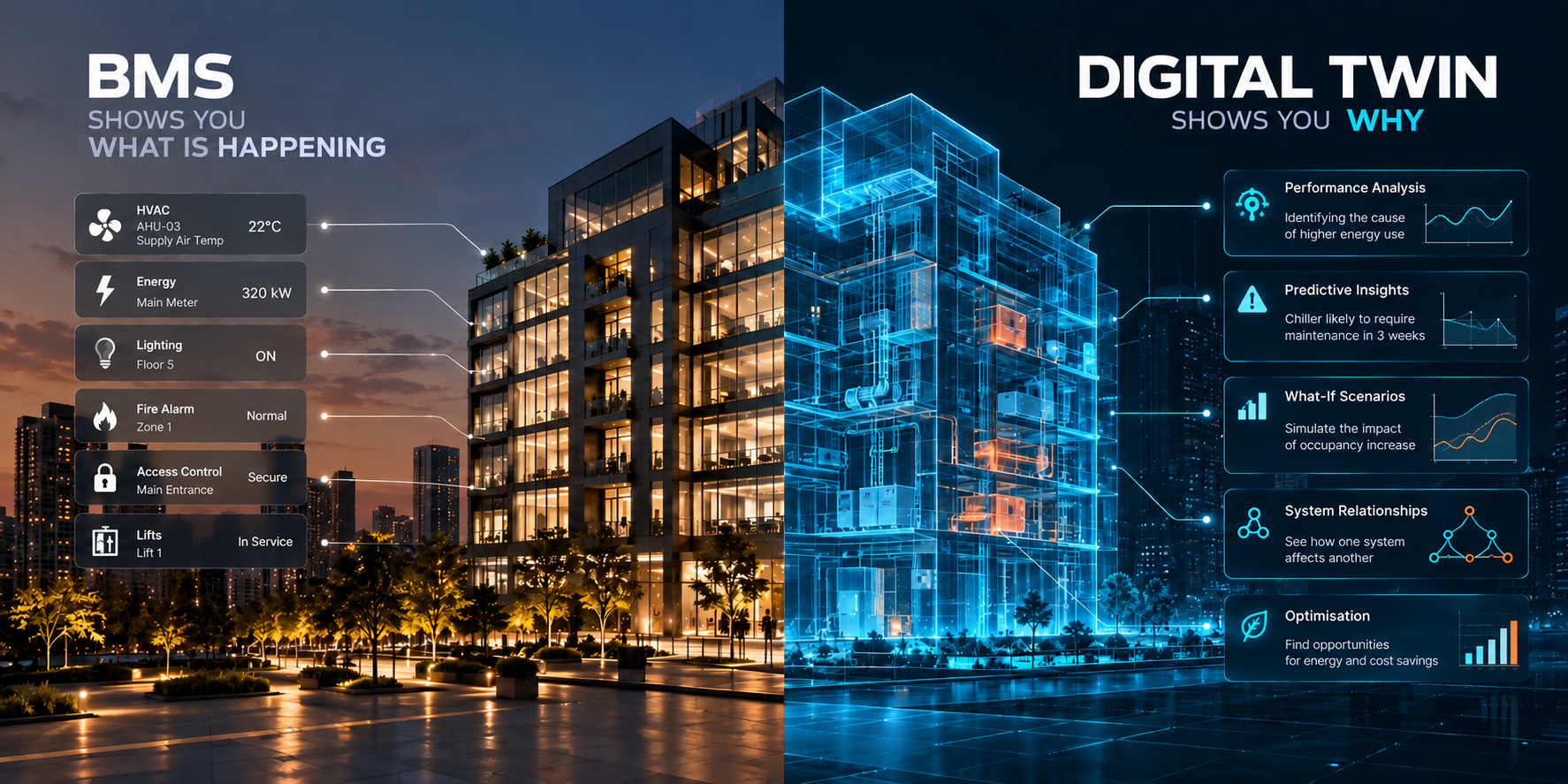
Modern buildings are no longer just physical spaces. They are increasingly connected environments where HVAC systems, energy meters, sensors, fire and life-safety systems, access control and other building services continuously generate operational data.
A Building Management System brings much of this information together, giving facility teams a way to monitor equipment, track conditions, respond to alarms and control connected systems. But having access to more data does not necessarily mean having a complete understanding of what is happening inside the building.
A change in energy consumption could be caused by equipment performance, occupancy, environmental conditions or the way different systems are interacting. An HVAC system behaving differently from its normal pattern may be showing a symptom rather than the underlying cause.
This creates a gap between seeing what is happening and understanding why it is happening.
And that leads to a more interesting question:
What if a building's operational data could be understood in the context of the physical systems, assets and relationships that produced it?
This is where the conversation around Digital Twins begins.
A Digital Twin does not simply replace a Building Management System (BMS), nor does every building with a BMS automatically need one. Instead, a Digital Twin can build on the operational data already being generated by a BMS, IoT sensors and other connected systems to create a richer representation of how the physical building behaves.
Recent research into operational building Digital Twins increasingly distinguishes them from static models by requiring live connectivity to building systems, sensors or BMS data and use during the operational phase of a building.
So the real question isn't: BMS or Digital Twin?
It's: If a building already has a BMS, what does a Digital Twin actually add?
BMS vs Digital Twin: The Difference in One View
At a high level, the two technologies operate at different layers of building intelligence.
| BMS | Digital Twin | |
|---|---|---|
| Primary purpose | Monitor and control building systems | Understand, analyse and model building behaviour |
| Typical data | Sensors, equipment status, alarms, setpoints | BMS + IoT + asset + historical + contextual data |
| Main question | What is happening? | Why is it happening, and what could happen next? |
| Control | Direct control of connected systems | Usually works alongside existing control systems |
| Analysis | Trends, alarms and operational monitoring | Diagnostics, modelling, prediction and what-if analysis |
| Representation | Dashboards, graphics, floor plans | Connected digital representation of physical assets and systems |
The distinction isn't that a BMS is "old" and a Digital Twin is "new." A modern BMS can already be highly sophisticated.
The difference is what you do with the data once you have it.
A BMS Knows the Building. A Digital Twin Connects the Dots.
Consider a commercial building with an integrated BMS. The BMS might receive data from:
- HVAC equipment
- temperature and humidity sensors
- electrical meters
- lighting systems
- pumps and chillers
- fire alarm systems
- access control
- other connected building equipment
The facility team can use that information to monitor equipment, identify alarms and adjust operating conditions. But the data can still exist as individual points, trends and alarms. A Digital Twin can add another layer of context.
Instead of looking at an AHU simply as:
AHU-03 → Supply air temperature: 17°C → Energy consumption: X → Alarm: None
the system can understand that AHU-03:
- serves a particular zone
- is connected to specific equipment
- operates according to a particular schedule
- responds to occupancy and environmental conditions
- has a historical performance pattern
- interacts with other systems
- is behaving differently from what its model or historical baseline suggests
That shift, from individual data points to relationships and context, is one of the reasons Digital Twins are becoming relevant to building operations.
What Does a Digital Twin Add to a BMS?
The answer depends on how the Digital Twin is designed and what data it can access. But there are several areas where it can extend conventional building monitoring.
1. From Monitoring to Diagnostics
A BMS can tell you that an HVAC system is consuming more energy than expected. A Digital Twin can use additional asset, environmental and historical information to investigate the behaviour and identify possible causes.
That can move facility management from "There is an abnormal reading." toward "This system is behaving differently from its expected operating pattern."
Digital Twin research in building maintenance increasingly focuses on combining BMS and IoT data for real-time monitoring, anomaly detection and predictive maintenance.
2. From Historical Data to What-If Scenarios
A dashboard can show what happened yesterday. A Digital Twin can potentially be used to explore scenarios before making a change to the physical building.
For example:
- What happens if occupancy increases?
- What happens if the HVAC schedule changes?
- What happens if a piece of equipment is replaced?
- How could a change in one system affect another?
This is where simulation and predictive models become important. Current research on Digital Twin–BMS architectures describes their use for prediction, optimization and what-if evaluation alongside live building data.
3. From Systems to a Building-Level View
- Modern buildings rarely operate as isolated systems.
- HVAC affects energy consumption.
- Occupancy affects HVAC demand.
- Lighting affects energy consumption and occupant comfort.
- Fire detection interacts with emergency systems.
- Access control provides information about occupancy and movement.
- IoT sensors add another layer of environmental and equipment data.
A Digital Twin can provide a framework for connecting these relationships rather than treating every system as a separate dashboard.
Does a Digital Twin Replace a BMS?
Usually, that's not the right way to think about it.
A BMS is responsible for monitoring and controlling building systems. A Digital Twin can use the information produced by those systems to create a richer operational model for analysis, diagnostics, simulation and decision support.
In other words:
The BMS operates the building and The Digital Twin helps you understand the building.
They can work together rather than being competing technologies.
An operational Digital Twin can ingest live data from BMS and IoT systems while adding modelling and analytical capabilities on top. This layered approach is reflected in recent building Digital Twin architectures and real-world implementations.
So, Does Every Building With a BMS Need a Digital Twin?
No.
A Digital Twin introduces additional data, modelling and integration requirements. For a relatively simple building with straightforward automation needs, a well-designed BMS may already provide everything the facility team needs.
The case becomes more interesting when a building has:
- multiple interconnected systems
- large amounts of sensor data
- complex HVAC and energy infrastructure
- multiple facilities or large campuses
- extensive IoT deployments
- predictive maintenance requirements
- energy optimization goals
- complex asset relationships
- a need to test operational changes before implementing them
In those environments, the question isn't whether a Digital Twin sounds more advanced.
The question is:
Can the additional layer of context, modelling and analysis produce decisions that a conventional monitoring and control system cannot?
That is the real value proposition.
The Architecture Matters More Than the 3D Model
One of the easiest ways to misunderstand Digital Twins is to think they are primarily about creating a 3D model of a building. A 3D representation can be useful, but the model itself isn't what makes a Digital Twin operationally valuable. The important part is the connection between the physical building and its digital representation.
A simplified architecture looks something like this:
Physical Building → Sensors & Equipment → BMS / IoT → Data & Context → Digital Twin → Analytics → Decision
The quality of the Digital Twin therefore depends on the quality of the data beneath it. That includes data from building systems, connected sensors, equipment, asset relationships and the operational context required to interpret them.
This is also why interoperability becomes important. Building Digital Twin architectures increasingly involve BMS, IoT, data models and communication protocols working together rather than existing as isolated systems.
BMS + IoT + Digital Twin: Where Building Intelligence Starts to Get Interesting
This is where the technologies begin to fit together
- BMS provides monitoring and control.
- IoT expands the building's ability to sense and collect data.
- Data platforms bring information from different systems together.
- Digital Twins provide a contextual representation of the physical environment.
- Analytics and AI can then use that information to identify patterns, anomalies and opportunities for optimization.
The result isn't simply another dashboard.
It is a system designed to help people understand what is happening, why it is happening, and what could happen next. And that is ultimately the difference between having more building data and having more building intelligence.
Was the blog insightful?
Subscribe to our newsletter so you never miss an update