
By Emkionyx Team ·
The Architecture of Programmable Trust: RERA 2.0, Smart Contracts, and the Digital Transformation of Indian Real Estate
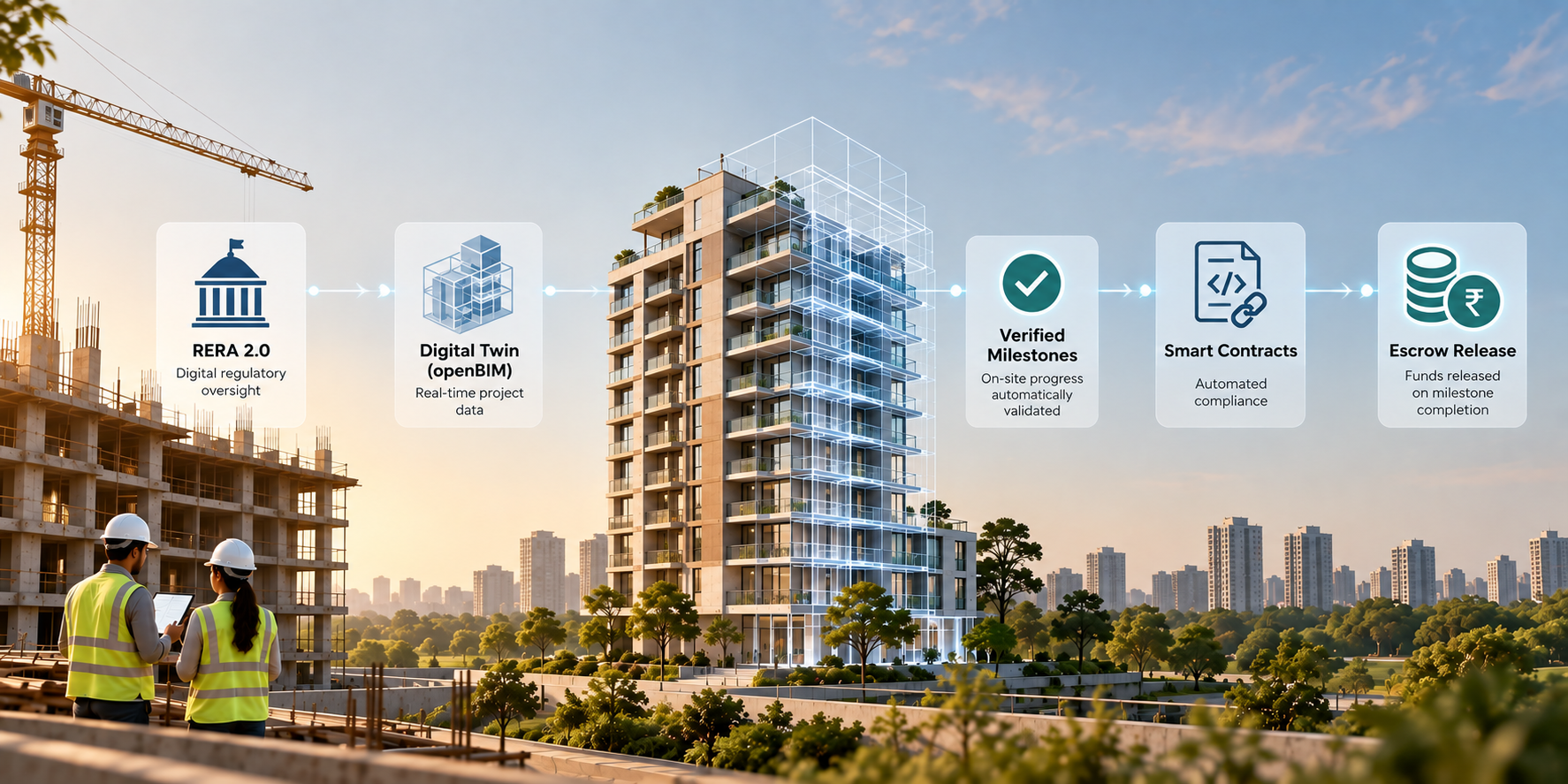
The Indian real estate and infrastructure landscape is currently navigating a pivotal transition from an era of institutional trust to one of programmable trust. This transformation, catalyzed by the emergence of RERA 2.0 and the adoption of decentralized technologies, represents a fundamental shift in how the built environment is financed, regulated, and delivered. At the center of this evolution is the recent discourse facilitated by building SMART India and the confederation of Digital Construction Practitioners India (CDCP India), particularly their focus on the integration of smart contracts to solve long-standing issues of transparency and accountability in the sector.1
The concept of programmable trust refers to a system where compliance, financial flows, and governance are automated through software code-specifically smart contracts-within regulated frameworks.3 In the context of Indian real estate, this means that the promises made by developers to homebuyers and regulators are no longer dependent on human volition alone but are hard-coded into digital systems that execute automatically upon the verification of specific conditions. This paradigm shift is essential for India as it seeks to achieve its ambitious infrastructure goals of more than $1.4 trillion and its vision for a developed nation by 2047.1
The Historical Imperative: From Opaque Markets to RERA 1.0
To appreciate the necessity of RERA 2.0 and programmable trust, it is necessary to examine the historical conditions that necessitated regulatory intervention. Before 2016, the Indian real estate sector was characterized by a pervasive lack of accountability. Developers frequently operated in a regulatory vacuum, leading to systemic abuses such as the widespread diversion of funds. It is estimated that 70% to 80% of funds collected from homebuyers were often diverted to land acquisition for new projects or to cover existing debts, rather than being utilized for the construction of the specific project for which they were intended.4
The consequences of this "cross-funding" model were catastrophic for the consumer. Average project delays ranged from four to six years, and by 2015, approximately ₹4.5 lakh crore was estimated to be stuck in stalled projects.4 Notable failures included the Amrapali Group, which diverted ₹3,000 crore, leaving 46,000 buyers stranded, and Jaypee Infratech, where 32,000 flats were delayed for over a decade.4
Comparative Framework of Pre-RERA Gaps and Regulatory Solutions
| Pre-RERA Deficit | Mechanism of Failure | RERA 1.0 (2016) Statutory Solution |
|---|---|---|
| Fund Security | Zero oversight on capital; funds diverted to land banking | Mandatory 70% escrow account for construction and land costs |
| Area Standardization | Use of "super built-up area" to inflate costs by 30-40% | Strict definition of "carpet area" as the basis for sale |
| Contractual Equity | One-sided agreements favoring the builder; no penalty for delay | Standardized model sale agreement; penalty of 2% above SBI MCLR for delays |
| Transparency | No central project tracking; approvals often hidden | Mandatory project registration and public disclosure on state portals |
| Dispute Resolution | 5-10 year cycles in civil courts (CPA 1986) | Dedicated State RERA authorities with 60-day resolution targets |
The Real Estate (Regulation and Development) Act of 2016 (RERA) acted as a "guardian" of the homebuyer's interests, effectively ending the era of unregulated expansion.5 It introduced the requirement for developers to disclose project details, including layouts and approvals, on official websites and mandated that 70% of project funds be kept in a separate escrow account.5 While RERA 1.0 significantly boosted buyer confidence-from 40% to 74% by 2023-it remained a largely administrative and reactive framework.4 The verification of construction milestones and the audit of escrow accounts still relied on manual certifications by architects and chartered accountants, creating a lag between physical progress and financial oversight.
The Emergence of RERA 2.0: A Digital-First Regulatory Paradigm
RERA 2.0 represents the evolution of this regulatory framework into a proactive, data-driven system. In this new phase, the focus shifts from mere registration to real-time monitoring and automated compliance.6 This transition is fueled by PropTech and AI, which are revolutionizing how buyers and developers operate. By 2025, the market has moved toward digital transactions where tamper-proof title records and blockchain-based contracts reduce fraud and improve settlement speeds.
The core of RERA 2.0 is the integration of the "digital twin" into the regulatory process. By utilizing Building Information Modeling (BIM), regulators can compare the physical progress of a building with its digital representation. building SMART India, a national initiative of CDCP India, is at the forefront of this effort, promoting openBIM standards that allow for the seamless exchange of trusted information across the built environment lifecycle.1
The Role of openBIM in Programmable Trust
OpenBIM is essential because it provides a software-agnostic language for data exchange. For programmable trust to work, the smart contracts governing fund releases must be able to "read" the construction data regardless of whether the developer is using Autodesk, Bentley, or any other BIM platform. building SMART India’s mission to support the adoption of International openBIM standards ensures that the Indian built environment is future-proof and interoperable.1
This interoperability is critical for large-scale infrastructure. For example, the National Capital Region Transport Corporation (NCRTC) has implemented BIM on massive railway projects, demonstrating how digital standards can manage the complexity of infrastructure delivery.1 When these standards are integrated with RERA 2.0, the regulatory authority can automatically verify if a developer has reached a specific construction milestone (e.g., the completion of the 10th-floor slab) before authorizing the release of funds from the escrow account.
Smart Contracts and the Automation of the Escrow Mechanism
The most transformative application of programmable trust in RERA 2.0 is the use of smart contracts to manage the 70% escrow account. A smart contract is a self-executing agreement where the terms are written directly into code. In the real estate context, the smart contract acts as an automated "gatekeeper" for project funds.3
In a traditional RERA escrow setup, the developer submits a certificate of completion to the bank to withdraw funds. In a RERA 2.0 setup enabled by smart contracts, the process follows a more rigorous, automated logic. The disbursement D of funds from the escrow account E can be modeled mathematically based on the verification of milestones M through the openBIM data environment:

In this equation,

represents a verification function that returns a value of 1 only if the digital twin and IoT sensors confirm the physical completion of milestone j , and Cj represents the pre-allocated cost for that specific phase. If the data from the site does not match the BIM plan, the function returns 0, and the funds remain locked. This eliminates the risk of human error or fraudulent certification, ensuring that the 70% of buyer funds are strictly utilized for construction.3
Benefits of Smart Contract Integration
The shift to smart-contract-governed escrow accounts provides several advantages for all stakeholders:
| Stakeholder | Benefit of Smart Contracts |
|---|---|
| Homebuyers | Absolute certainty that their money is only being spent on their specific building. |
| Developers | Faster disbursement of funds upon milestone completion, improving liquidity and reducing the "velocity of capital" lag. |
| Banks/Lenders | Reduced risk of project stalling; automated auditing of project health. |
| Regulators | Real-time visibility into the financial and physical health of every registered project. |
| Subcontractors | Automated payments upon verified delivery of work, reducing disputes and payment cycles. |
Digitalization of Urban Rights: The TDR Case Study
The principles of programmable trust are not limited to building construction; they are also being applied to the management of urban development rights. The Transferable Development Rights (TDR) system in India is a prime candidate for digitalization. TDR allows the transfer of development potential from a "sending zone" (e.g., land surrendered for a park) to a "receiving zone" (e.g., a high-density residential area).7
Historically, the TDR market was opaque and vulnerable to double-selling. However, a major shift is occurring, with Mumbai mandating that all TDR transfers must be conducted via digital platforms starting July 2025.7 These platforms utilize Aadhar-linked registration to ensure that only the legitimate holder of a Development Rights Certificate (DRC) can trade their rights.7
The TDR Trading Workflow in a Programmable Trust Environment
The digital TDR platform facilitates a 5-step process that mirrors the functionality of a smart contract:
- Aadhar-Linked Registration: Every applicant and holder must register using their Aadhar number, creating a verified digital identity.7
- Digital Verification: Ownership is verified through the municipal real-time database, showing current certificate holders and transaction timestamps.7
- Smart Settlement: When a trade is initiated, the platform facilitates an escrow arrangement. The buyer's funds are held by a nodal bank.7
- Automated Endorsement: Upon the buyer signing the digital transfer agreement and the seller verifying with an OTP, the municipal authority updates the certificate in the register.7
- Fund Release: Once the municipal endorsement is recorded on the ledger, the escrowed funds are automatically released to the seller.7
This system eliminates brokers, prevents fraudulent double-sales, and ensures that stamp duty and registration charges are calculated and paid automatically based on the current market value of the TDR.7
AI and Machine Learning: Extending Trust through Predictive Analytics
While smart contracts handle the execution of trust, Artificial Intelligence (AI) and Machine Learning (ML) are being used to generate the insights that inform that trust. In 2025, AI is being deployed across the Indian real estate lifecycle to improve underwriting and reduce risk.6
For instance, AI-driven demand forecasting and automated valuation models allow investors to identify underpriced micro-markets with high growth potential.6 In the mortgage sector, AI is being used by Non-Banking Financial Companies (NBFCs) to serve "credit-invisible" populations-individuals who have the financial capacity to buy a home but lack a traditional credit score.8
Impact of AI on Mortgage Integrity
One Indian NBFC serving first-time homebuyers deployed an AI-based fraud detection agent to analyze alternative data sources. The implementation led to several high-order impacts:
- Enhanced Detection: A 30% improvement in fraud detection rates by identifying non-linear patterns of deception in application data.8
- Reduced Friction: A decrease in false positive rates, allowing legitimate borrowers to move through the approval process faster.8
- Financial Inclusion: The model successfully extended credit to 15,000 customers who would have been rejected by traditional underwriting.8
- Portfolio Stability: Despite serving a higher-risk demographic, the company maintained portfolio performance metrics within strict target ranges.8
This application of AI creates a "programmable trust boundary" between the lender and the borrower. By using data gateways to neutralize "tool-poisoning attacks" or fraudulent inputs, lenders can safely scale their operations in a high-growth market like India.8
Global Capability Centers (GCC) and the Demand for Smart Infrastructure
The move toward RERA 2.0 and programmable trust is also driven by the needs of global institutional investors and occupiers. India has become a preferred destination for Global Capability Centers (GCCs), with companies setting up specialized hubs for AI, cloud-native architecture, and senior technical leadership.10
The choice of city for a GCC is a sophisticated decision involving a trade-off between talent depth and operational cost. Bangalore remains the leader for technology-first GCCs requiring cutting-edge skills in AI/ML, despite having costs that are 15-20% higher than other cities.10 Pune, conversely, offers an optimal cost-to-quality ratio for automotive and manufacturing GCCs, delivering 15-20% savings while maintaining strong retention rates.10 Delhi NCR is favored for operations requiring proximity to regulatory bodies and C-suite leadership.10
These institutional occupiers demand "Grade-A" real estate that is managed via digital twins and sustainable practices. The adoption of openBIM and smart contracts provides these global firms with the assurance that the buildings they lease are compliant with both Indian law (RERA) and international sustainability standards.1
Organizational Leadership: building SMART India and CDCP India
The successful implementation of RERA 2.0 and programmable trust relies on the collaborative efforts of industry bodies. building SMART India is a national level initiative of the Confederation of Digital Construction Practitioners India (CDCP India), aimed at promoting interoperability across the life cycle of the built environment.1
Under the leadership of figures like Vikas Srivastava, a strategic BIM advisor with two decades of experience across the USA, Europe, and India, these organizations are re-engineering business processes to adopt digitalization.11 Their initiatives include:
- DBI (Digital Build India): A series of virtual and regional extensions that share best practices, such as BIM implementation on railway projects by NCRTC.1
- BIM Bootcamps: Intensive training programs designed to address the "talent readiness" gap in the AEC (Architecture, Engineering, and Construction) industry.12
- Innovation Awards: Recognizing excellence in digital project management, such as the D360 Secure platform, which recently won awards for innovation in project management.12
These efforts are crucial because the technical adoption of smart contracts and RERA 2.0 requires a workforce that understands both the legal and digital dimensions of construction. The mission of building SMART India is to provide an inclusive and collaborative forum for the Indian community to participate in the development of global digital standards.1
The Economic Revival and the Path to 2047
The digitalization of real estate is not occurring in a vacuum; it is part of a broader economic revival. Following the challenges of the pandemic, organizations like CREDAI-MCHI have worked closely with government stakeholders to kick-start the revival of the Mumbai Metropolitan Region (MMR).13 Policies such as stamp duty reductions and concessions in premiums have provided the necessary impetus for a surge in enquiries, walk-ins, and home loan disbursements.13
As the sector moves forward, the focus is shifting toward "Viksit Bharat" (Developed India) by 2047. This vision requires the infrastructure delivery process to be world-class. Indian EPC (Engineering, Procurement, and Construction) companies like AFCONS are already adopting new technologies to meet these goals.1 The digitalization of infrastructure delivery ensures that large-scale projects are completed on time and within budget, reducing the national burden of stalled capital.
Sectoral Trends Shaping 2025-2026
The real estate market in 2025 is defined by several key trends that align with the goals of RERA 2.0:
| Trend | Market Driver | Technological Enabler | |
|---|---|---|---|
| Sustainability | Demand for green builds in Tier-1 cities like Bengaluru and Pune. | Digital twins for energy modeling and capex vs. rental upside simulation. | |
| Rental Market Growth | Professionals preferring flexible renting over ownership. | Automated lease-up models and institutionalized property management. | |
| Tier-2 Expansion | Improved infrastructure and NRI investments in smaller cities. | Remote project monitoring via BIM and cloud-based RERA compliance. | |
| Data-Driven Investment | Shift from traditional brokerage to algorithmic valuation. | AI models for neighborhood-level rent trajectories and renovation ROI. |
Conclusion: The New Social Contract in Real Estate
The convergence of RERA 2.0, smart contracts, and openBIM standards represents a new social contract between the state, the developer, and the citizen. By encoding trust into the very infrastructure of the market, India is overcoming the legacy of fragmentation and opacity. The "programmable trust" paradigm ensures that every rupee invested by a homebuyer or a global institution is protected by the objective, immutable logic of a digital system.3
Through the efforts of building SMART India and CDCP India, the industry is not just adopting new software; it is adopting a new philosophy of delivery. As the country moves toward its 2047 goals, the ability to exchange trusted information seamlessly across the built environment will be the primary determinant of success.1 RERA 2.0 is the legal architecture for this future, and smart contracts are the engine that will drive it toward transparency, inclusivity, and growth.
For the stakeholders who missed the recent webinar, the message is clear: the transition to a digital-first, programmable real estate market is no longer a future possibility-it is the current reality. Developers, investors, and practitioners who fail to integrate these digital standards into their workflows risk obsolescence in an era where trust is no longer a promise, but a program.1
Works cited
- Building Smart India, accessed May 7, 2026, https://www.buildingsmart.in/index.html
- Page 1756 - Ani/10: Ani/10 - Read all News, Stories, Videos and Photos from Ani/10 | Business Standard, accessed May 7, 2026, https://www.business-standard.com/author/ani/10/page-1756
- How Are Firms Bridging the World of TradFi and DeFi? | The Fintech Times, accessed May 7, 2026, https://thefintechtimes.com/how-are-firms-bridging-the-world-of-tradfi-and-defi/
- Pre-RERA Real Estate Challenges Explained | PDF - Scribd, accessed May 7, 2026, https://www.scribd.com/document/872575004/All-About-Real-Estate
- RERA Act 2016 - (Real Estate Regulation & Development) - MagicBricks, accessed May 7, 2026, https://www.magicbricks.com/blog/what-is-rera/125759.html
- Top 10 Real Estate Trends Shaping India in 2025, accessed May 7, 2026, https://ashwinderrsingh.com/blog/indian-real-estate-market-trends
- Understanding TDRs in India: A Guide | PDF | Taxes - Scribd, accessed May 7, 2026, https://www.scribd.com/document/954949512/REM-Prompts
- Faster Approvals: The Impact of AI for Mortgage in 2026 - VLink, accessed May 7, 2026, https://vlinkinfo.com/blog/ai-for-mortgage
- Remote MCP Servers: Inevitable, Not Easy - The New Stack, accessed May 7, 2026, https://thenewstack.io/remote-mcp-servers-inevitable-not-easy/
- GCC Cost & Talent Analysis: Bangalore, Pune, Delhi NCR - VLink, accessed May 7, 2026, https://vlinkinfo.com/blog/gcc-cost-talent-analysis-guide
- About DGTRA | Leading BIM Consultant in Digital Construction, accessed May 7, 2026, https://www.dgtra.com/about/
- News & Event - DGTRA, accessed May 7, 2026, https://www.dgtra.com/category/news-event/
- supporting partners - CREDAI – MCHI, accessed May 7, 2026, https://www.mchi.net/pdf/CREDAIMCHI_ANNUALREPORT_2021.pdf
Was the blog insightful?
Subscribe to our newsletter so you never miss an update